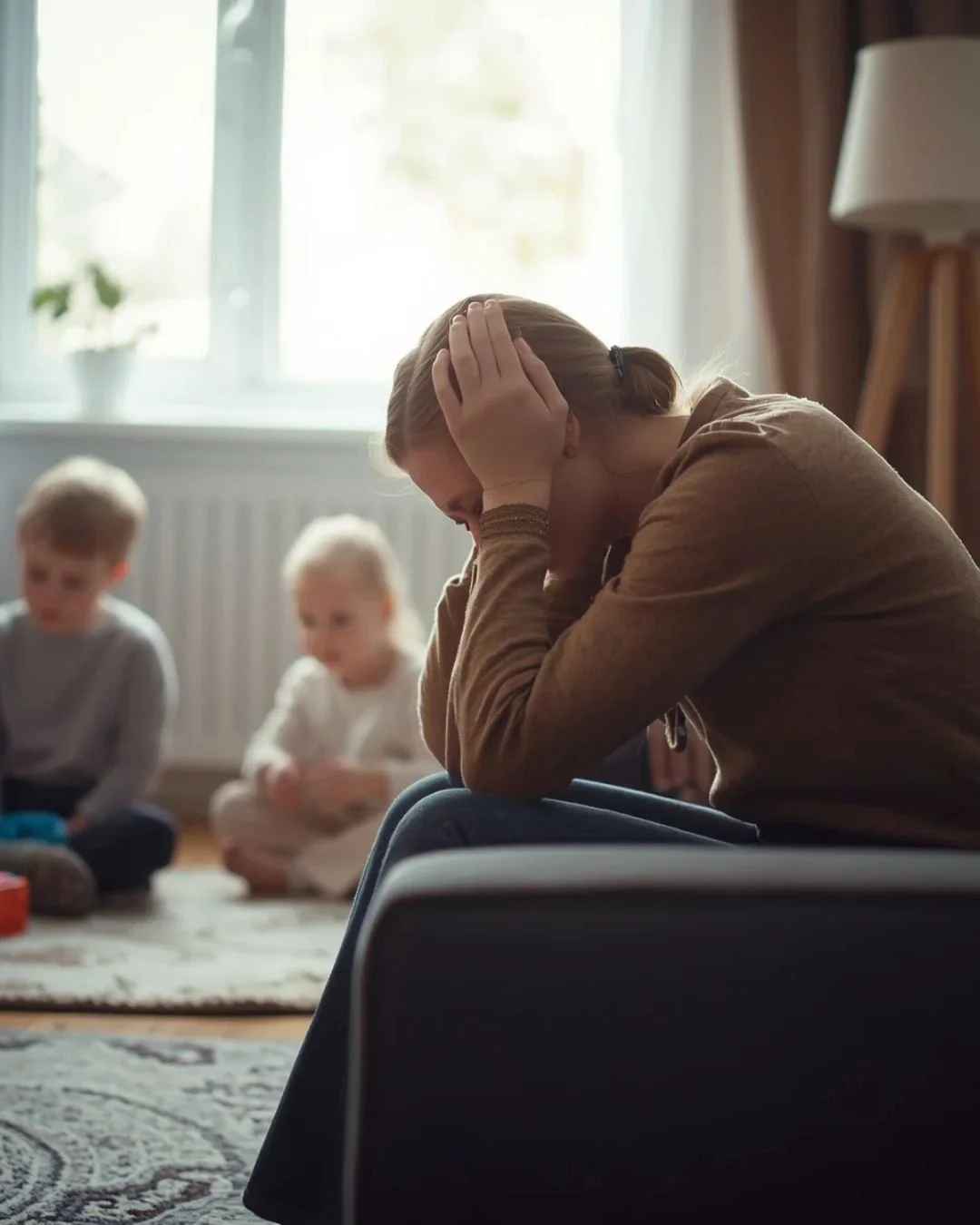
What Is Your Anxiety Costing Your Children?
You would never let another adult speak to your child the way you sometimes do.
You would never tolerate someone screaming at your child because they spilled their milk, refused to put on their shoes, or interrupted them at the wrong moment. And yet, behind closed doors, you migh find yourself doing exactly that.
You lose your patience. You raise your voice. You say something you regret. Sometimes your anger becomes so intense that you barely recognize yourself. And afterward, when you see the look on your child’s face, you’re flooded with guilt.
You apologize, you hug them, and you promise yourself you’ll do better tomorrow. But tomorrow comes, and the same thing happens.
Or maybe anger isn’t your biggest struggle. Maybe you’re constantly distracted. You’re physically with your kids, but your mind is always somewhere else. You’re thinking about work, anticipating the next problem, or trying to stay on top of everything that needs to get done.
You love your kids more than anything. You want to enjoy them and you want to be patient, present, and connected. But so much of your experience of motherhood feels like something you’re trying to manage rather than something you’re actually living. And somewhere along the way, you’ve started telling yourself that this is just what motherhood feels like.
I want to challenge that assumption. Because while anxiety, overwhelm, and emotional reactivity are incredibly common experiences in motherhood, that doesn’t mean we should accept them as inevitable.
Especially when we begin to understand how they’re likely be affecting our kids.
Your children are experiencing your anxiety, too.
Consider a few situations that happen in homes every single day.
The baby who won’t stop crying
You’ve fed her, changed her, rocked her, and walked around the house with her. You’ve checked everything you can think of, and nothing is working.
You can feel yourself becoming increasingly tense. Your heart is racing, your shoulders are tight, and your mind is moving a hundred miles an hour, trying to figure out what you’re missing. Why can’t I figure this out? What’s wrong? What am I supposed to do?
You love this baby more than anything in the world, and you would do anything to make her feel better. But what you may not realize is that while you’re desperately trying to calm her, she’s also responding to you.
Your baby doesn’t understand your thoughts. She doesn’t know you’re worried about her sleep schedule or wondering whether something is medically wrong. But she’s sensitive to your voice, your touch, your facial expressions, and the way you’re holding her. And when you’re becoming increasingly distressed, it becomes harder for her to settle, too.
Your baby’s crying may be triggering your anxiety. And your anxiety may be making it harder for you to offer the steady, responsive presence that helps her feel safe.
Neither of you is doing anything wrong. But you’re influencing each other.
The toddler whose tantrums seem to be getting worse
Your four-year-old is having a meltdown because you told him it’s time to leave the playground. You’ve given him warnings, you’ve explained why you need to go, and you’ve offered choices. You’ve tried every parenting strategy you know.
And now you’re furious and you can feel your patience disappearing. You’re embarrassed because other parents are watching. You’re worried about being late. And underneath all of that, you’re thinking, Why does everything have to be so difficult?
You raise your voice. He screams louder. You threaten to take away something he loves. He throws himself on the ground. You’re both completely overwhelmed.
You might walk away from that experience believing your kid needs to learn how to manage his emotions, and he does. But there’s something else worth considering. Your child is learning how to manage his emotions in a relationship with you.
He’s learning what happens when someone becomes frustrated. He’s learning how people respond when things don’t go their way. He’s learning whether difficult feelings can be experienced without the relationship becoming frightening or unpredictable. And in that moment, he’s not the only one struggling to regulate.
What if some of the intensity you’re seeing in your child is being amplified by the intensity you’re bringing into the interaction? What if the very behavior you’re trying so hard to stop is becoming more difficult because both of you are overwhelmed?
The eight-year-old who stops trying to get your attention
Your daughter comes home from school and wants to tell you about something that happened with a friend. You’re making dinner, answering a work message, and thinking about everything that still needs to happen before bedtime.
You’re listening. Sort of. “Uh-huh. Really? That’s frustrating.” She keeps talking, but you’re distracted. Eventually, you say, “Honey, can we talk about this later? I have a million things to do.”
She stops talking.
You don’t think much of it. You’re busy and you’ll ask her about it later. But your daughter might be learning something from these repeated interactions.
She might be learning that your attention is difficult to access. She may be getting the message that her problems are interruptions. She is very likely learning that connection is something that happens when everything else is finished. And over time, she may stop trying quite so hard to get your attention.
This doesn’t happen because she doesn’t need it anymore. It happens because she’s learning what to expect. You might eventually notice that she doesn’t tell you as much as she used to and you might wonder why she’s becoming more private or less interested in spending time with you.
But have you considered that the distance you’re noticing may have been developing through hundreds of ordinary moments when you were physically present but emotionally somewhere else?
Your children are learning what relationships feel like from you.
I want to say something that I think we need to be talking about much more openly. Your anxiety doesn’t exist in isolation. Neither does your overwhelm, your impatience, your irritability, or your tendency to be mentally somewhere else when you’re physically with your kids.
These experiences influence the emotional environment in which your children are growing up. And that environment is helping shape how they understand themselves, other people, and relationships.
For more than 20 years, I’ve worked with mothers who love their children deeply and are doing everything they can to give them a healthy, secure childhood. They’re reading parenting books, listening to podcasts, learning about emotional development, and trying to use the right language. They are working hard to respond rather than react. But many are missing something important.
The emotional experience your child has in a relationship with you is influenced by more than what you say or do. It’s also influenced by the state you’re in when you’re with them.
And if you’re living in a chronic state of anxiety, tension, or emotional overwhelm, that deserves your attention because your kids are learning from their experiences with you every day.
They’re learning what happens when someone is upset and whether mistakes are safe to make. They’re learning how people respond to frustration and whether difficult feelings can be tolerated. They’re learning what it feels like to need someone. And they’re learning what to expect from the people they love.
This is how relationships shape us. Not through one perfect conversation or one terrible afternoon, but through the experiences we have with each other over time.
What happens behind closed doors deserves our attention, too.
There’s another experience I want to talk about because I think it’s happening in far more homes than we’re willing to acknowledge.
Mom rage.
I’m talking about the moments when your frustration becomes so intense that you barely recognize yourself. You scream at your child over something relatively small. You slam a door or throw something across the room. You grab your child’s arm more roughly than you intended. You say something cruel that you would never dream of saying to another person.
And then, almost as quickly as the anger arrived, you’re flooded with regret.
You look at your child’s face and realize that you’ve frightened them. You apologize, you hug them, and you tell them how much you love them. And you promise yourself it will never happen again.
But then another difficult morning comes. There’s another bedtime battle or another moment when everyone needs something from you and you have nothing left to give. And it happens again.
I’ve worked with moms who are extraordinarily capable, thoughtful, loving women and who are deeply ashamed of how they sometimes behave with their kids. They can manage complicated situations at work, they can navigate difficult conversations, and they can remain composed under enormous pressure. But at home, with the people they love most, they sometimes become almost unrecognizable to themselves.
We need to be willing to talk about what this means because while your rage may last only a few minutes, your child experiences those minutes, too.
Your child doesn’t know that you’ve been awake since 4 a.m. worrying about work. They don’t understand the pressure you’re putting on yourself to keep everything running. They don’t know that underneath your anger is often anxiety, exhaustion, helplessness, or fear.
They experience your raised voice, your expression, your movements, and the sudden change in the emotional atmosphere around them, and when these experiences happen repeatedly, children may begin to anticipate them.
They might become more watchful of your moods and they might become anxious about making mistakes. They might learn to hide difficult feelings or avoid coming to you when something goes wrong. Or they might respond with greater anger, resistance, and emotional intensity of their own. This is very often what ends up happening.
None of these outcomes is inevitable, but they are real possibilities we need to take seriously. Because the fact that you don’t mean to frighten your child doesn’t mean your child isn’t frightened.
We can understand why a mom is overwhelmed and we can absolutely recognize the enormous pressures she’s carrying. We can have tremendous compassion for the anxiety, exhaustion, and emotional overload that contribute to her reactions.
And we can still recognize that repeated episodes of rage can affect a child’s sense of safety. Those truths can exist together. Understanding why you’re losing control doesn’t eliminate the impact of losing control. And understanding your behavior is not the same as changing it.
Your children are borrowing your nervous system.
One of the most important things to understand about child development is that children don’t arrive in the world knowing how to regulate their emotions. They develop that capacity through repeated experiences with the adults who care for them.
We call this co-regulation.
When your baby is distressed, your calm voice, steady touch, and responsive presence can help her nervous system settle. When your toddler is overwhelmed, your ability to stay grounded can help him move through an experience he doesn’t yet have the capacity to manage on his own. When your school-age kid is upset, your ability to remain emotionally available can help her feel understood and supported while she learns to navigate increasingly complicated emotions.
In a very real sense, our children borrow our capacity to regulate before they develop more of their own. But consider what happens when the adult they depend on is chronically overwhelmed.
When your nervous system is constantly preparing for the next problem, anticipating what might go wrong, or reacting to ordinary childhood behavior as though it’s an emergency, it becomes harder to offer the steady presence your kiddo needs. And children are remarkably sensitive to the emotional states of the people around them.
They notice tension. They notice impatience. They notice when your attention is somewhere else. They notice when small problems create big reactions.
That doesn’t mean your child will become anxious every time you’re anxious— children are influenced by many relationships and experiences. But when tension, unpredictability, or emotional disconnection becomes a repeated part of family life, it can affect how safe and secure children feel.
And this is where I think we need to have an even more important conversation.
Secure attachment isn’t built through perfect parenting. It’s built through repeated experiences of safety.
One of the strongest foundations for healthy emotional and social development is a secure attachment relationship.
Children develop secure attachment through repeated experiences of having caregivers who are responsive, emotionally available, and able to provide comfort when they need it. Over time, these experiences help kids develop a sense that they’re worthy of care, that other people can be trusted, and that they have somewhere safe to turn when life becomes difficult.
And here’s what I want mothers to understand. Your child doesn’t develop that sense of safety simply because you love them. They develop it through repeated experiences of feeling safe with you.
Love is essential. But love and emotional availability aren’t always the same thing.
You can love your kiddo more than anything and still be so consumed by anxiety that you’re struggling to be present. You can want your kiddo to feel safe and still respond to their distress with frustration or impatience. You can be deeply committed to raising an emotionally healthy child and still find yourself repeating patterns that make emotional connection more difficult. And if those patterns become the dominant experience in your relationship, they deserve serious attention.
A child’s sense of safety isn’t something we can create through words alone. It’s something they experience in our voices, in our expressions, in the way we respond when they’re struggling, in whether they can come to us with difficult feelings without worrying about how we’ll react, in whether they can make mistakes without becoming afraid of our anger, and in whether we can remain emotionally available when life isn’t going the way we want it to.
Of course, secure attachment doesn’t require parents to be calm all the time and it doesn’t require us to meet every need immediately or respond perfectly to every difficult moment. It also doesn’t mean that having anxiety prevents someone from being a securely attached parent. But we need to stop treating chronic anxiety and emotional reactivity as though they’re only problems for the mother.
They can — and often will— become problems within the relationship. And when we recognize that, we have an opportunity to do something about it.
What if your child’s behavior isn’t the only thing that needs your attention?
Think about how much time parents spend trying to change their children’s behavior.
We want our babies to stop crying, our toddlers to stop having tantrums, our school-age kids to listen the first time, and our teenagers to communicate more openly.
We look for strategies, set boundaries, try consequences, and search for explanations. Sometimes those things are helpful. But I want to offer you a different question that requires a little courage. What part might I be playing in the very things I wish were different?
I’m not asking you to blame yourself for your child’s behavior. Your child is a separate human being with their own temperament, developmental needs, feelings, and experiences. You are not responsible for every emotion they have or every choice they make. But you are an active participant in the relationship you’re building together. Your emotional state, your expectations, your reactions, and your ability to remain connected when things become difficult all influence that relationship.
If your toddler’s tantrums consistently send you into a state of panic or rage, what might happen if you developed a greater capacity to tolerate his distress?
If your child’s resistance immediately triggers your need to take control, what might change if you could recognize that reaction before acting on it?
If your teenager has stopped coming to you with difficult feelings, what might you discover if you became curious about how you’ve responded to those feelings in the past?
These aren’t comfortable questions. But they’re really, really important ones. Because sometimes we’re so focused on trying to change our children that we overlook the ways our own patterns may be contributing to the dynamics we’re struggling with.
And unlike your child’s behavior, your patterns are something you can begin to change.
The greatest risk may be waiting for motherhood, and life, to get easier.
Here’s something I’ve noticed after working with thousands of mothers.
Many women are waiting. Waiting for their babies to sleep through the night. Waiting for their toddlers to become more cooperative. Waiting for their children to become more independent. Waiting for work to settle down. Waiting for life to feel less demanding.
They believe that when their circumstances change, they’ll finally become the patient, present, connected mothers they want to be. And sometimes circumstances do get easier, but the patterns we’ve developed for managing uncertainty, discomfort, and overwhelm don’t necessarily disappear when life becomes less demanding.
If your instinct is to respond to uncertainty by trying to control everything, you’ll likely continue finding things to control.
If you experience your child’s distress as something you need to fix immediately, you’ll continue struggling when you can’t make their feelings go away.
If you’ve spent your life believing that being capable means being able to handle everything, you may continue feeling inadequate whenever motherhood presents something you can’t manage.
And all the while, your children are growing up. They’re developing expectations about relationships. They’re learning how people respond to difficult emotions. They’re forming beliefs about themselves and the world around them. And you’re spending years of their childhood feeling anxious, frustrated, distracted, and disconnected.
At what point does waiting for things to get easier become a greater risk than doing the uncomfortable work of changing how you’re showing up today?
Knowing how to be a good mother isn’t the same as being able to access that version of yourself.
I think this is one of the most frustrating experiences of motherhood for high-achieving women.
You know what you want to do. You know yelling isn’t helpful, you know your child needs connection, and you know that staying calm is more effective than losing your temper. And yet, when things become difficult, you find yourself doing the exact things you promised yourself you wouldn’t do.
It’s easy to interpret that as a personal failure, but there’s another explanation. You’ve spent years developing the ability to solve problems, anticipate challenges, plan ahead, and maintain control. Those abilities have worked in so many parts of your life. But children are unpredictable. Their emotions don’t follow your schedule, their development doesn’t happen according to your plans, and relationships can’t always be managed through problem-solving.
Sometimes what your child needs most is your ability to remain present when something is difficult. They need you to tolerate their distress without becoming overwhelmed by it and to recognize your own emotional reactions without automatically acting on them. They need you to stay connected even when you don’t know what to do.
This is what I call relational intelligence.
It’s the ability to stay engaged with reality as it is, especially when things feel uncertain or uncomfortable, so you can choose how to respond rather than being driven by your automatic reactions. And it’s something you can develop.
That work begins with awareness— Recognizing what happens inside you when your child is upset, resistant, or unpredictable and understanding the expectations and deeply learned beliefs that shape your reactions.
It’s earning to distinguish between what’s actually happening and the story your mind is telling you about it and developing the nervous system capacity to remain present with discomfort long enough to make a choice.
Because the goal isn’t to become a mother who never experiences anxiety, frustration, or anger. It’s to become a mother who can experience those feelings without automatically allowing them to determine how she responds to her children.
Your children don’t need you to get everything right. But they do need you to take your patterns seriously.
Every parent gets frustrated and every parent becomes distracted. Every parent has moments when they respond in ways they wish they hadn’t, and children don’t need perfectly calm, endlessly patient parents. They need relationships in which they can experience connection, safety, and repair.
Repair is one of the most important parts of a healthy relationship. When you lose your patience and return to acknowledge what happened, take responsibility, and reconnect, you’re teaching your child something valuable. You’re showing them that relationships can withstand difficult moments. You’re modeling what it looks like to make mistakes and take responsibility. You’re showing them that conflict doesn’t have to mean the end of connection.
But I also think we need to be careful about using the importance of repair to minimize the impact of repeated patterns. Apologizing after you yell is important, but developing the capacity to respond differently in the first place is important, too. And if you find yourself apologizing for the same behavior over and over again, that may be a sign that something deeper needs your attention.
If you’re repeatedly frightening your child with your anger, waiting until the next time you lose control to promise yourself you’ll do better isn’t enough. That pattern needs attention now.
And if your anger has reached the point where you’re afraid you might hurt your child, it’s important to create immediate safety, step away when your child can be left safely, and get professional support.
Seeking help isn’t an admission that you’re a bad mother. Quite the contrary, actually. It’s a sign that you care enough to step out of your familiar patterns and acknoledge that something needs to change.
What is staying where you are costing you and your children?
I want you to consider that question seriously.
What is the cost of another year spent feeling constantly overwhelmed? Another year of being physically present but mentally somewhere else? Another year of reacting to your child’s distress with frustration, panic, or anger? Another year of promising yourself that tomorrow you’ll be more patient?
I’m not asking you to imagine the worst possible outcome for your child, Im asking you to consider what is happening in your relationship right now. Because your children are growing up inside the relationship you’re creating with them today. And while you cannot control every experience they have or guarantee how they’ll develop, you have huge influence over the emotional environment in which they’re growing.
You have influence over how you respond to their distress, how you handle conflict, how you repair after difficult moments, how you make yourself available for connection, and how you care for your own nervous system so you have greater capacity to be present with theirs. You don’t have to wait for your kids to change before you begin changing your experience of motherhood. Please don’t.
You can begin developing the capacity to stay present when things are hard, to recognize when your anxiety is driving your behavior, to tolerate uncertainty without immediately trying to control it, and to respond to your children from a place of greater awareness, steadiness, and choice. And as those capacities grow, something important becomes possible.
You can begin to experience your children differently. And they can begin to experience you differently, too.
Your children’s childhood is happening now. The relationship you’re building with them is happening now.
The question is whether you’re willing to look at what’s happening closely enough to begin changing it.
Ready to change the patterns that are keeping you stuck?
If you recognize yourself in this article, I invite you to join my free monthly workshop.
We’ll explore why knowing what to do as a parent isn’t always enough, how anxiety and overwhelm influence the way you respond to your kids, and how developing relational intelligence can help you stay connected when motherhood gets difficult.
You already know how much you love your children. Let’s work on helping you experience that love, and helping them experience it, even when motherhood gets hard.