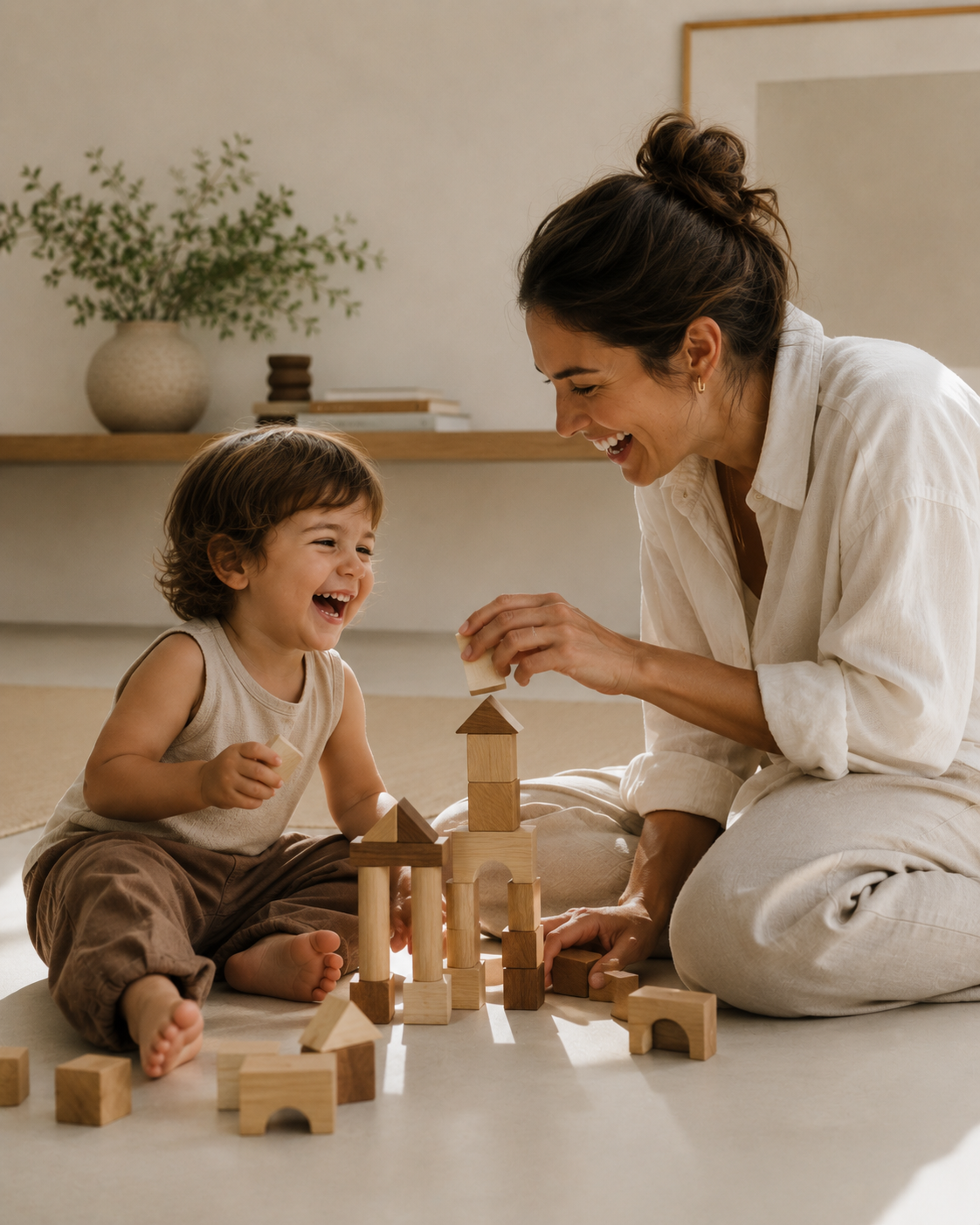
Why Play can Feel So Hard for High-Achieving Mothers
“I hate playing with my kid.”
This is one of the most common things mothers quietly tell me. And it’s usually it’s followed by:
“I know I should enjoy this.”
“I just want to have fun.”
“I feel terrible that I don’t.”
If you’ve ever felt this way, you’re not alone. And it doesn’t mean you’re a bad mom. I actually think something much more interesting is happening.
Most high-achieving women have spent decades developing what I call strategic intelligence. It’s the ability to plan, solve, organize, anticipate, improve, optimize, and achieve. These are incredible strengths. They’re probably part of what helped you build a meaningful career, take care of others, and accomplish things you’re proud of.
But play doesn’t speak the language of strategic intelligence. Play asks something entirely different of us.
When you’re coloring with your four-year-old, there isn’t a goal to accomplish. When you’re pretending to be dinosaurs or having a tea party with stuffed animals, there isn’t a prize for doing it well. There isn’t a checklist and there isn’t an efficient way to get through it. All those markers of success we’re used to really don’t matter here. In fact, the moment you start asking, How long do I have to do this? Am I doing enough? Is this good for my child? What should we play next? you’ve quietly stepped out of play and back into performance.
Strategic intelligence is trying to turn play into another project, and that’s exactly what makes it exhausting.
True play isn’t productive, it’s relational. It’s about being willing to enter your child’s world instead of asking them to enter yours. And, quite honestly, it’s about letting go of any agenda at all. That’s why play can feel surprisingly uncomfortable. It requires us to tolerate slowness. Uncertainty. Imagination. Following instead of leading. And these are the very capacities our achievement-focused culture rarely asks us to practice.
Ironically, they’re also the capacities that create the moments we long for. The laughter. The inside jokes. The spontaneous dance party in the kitchen. The cardboard box that somehow becomes a spaceship. Playfulness. Those moments aren’t things we can manufacture. They happen when we stop trying to produce an experience and simply participate in one.
I don’t believe the goal of motherhood is to become someone who loves pretending to be a princess for three straight hours. At least I hope not because, quite honestly, I hated that. The goal is something much more meaningful. The goal is to become fluent enough to recognize that this moment doesn’t need your strategy. It needs your presence.
This is the most beautiful part! The same relational intelligence that allows you to truly play with your child is the intelligence that helps you experience joy. Joy isn’t something you achieve after the dishes are done and it isn’t the reward for finally getting everything right. Joy is what becomes available when you step out of performance and into relationship.
Your child isn’t asking you to be entertaining, they’re inviting you to be with them. And perhaps, without realizing it, they’re also inviting you back to a part of yourself that has been waiting to play, too.