The Disease of Unfulfillment: When Loving Motherhood Isn’t the Same as Feeling Alive
If you are a stay-at-home mom and thriving, this isn’t for you.
Really.
This is not about whether women should stay home with their children or pursue meaningful work outside of motherhood. I have no judgment here. Some women feel deeply fulfilled raising their children full-time. They love it. It fits who they are. If staying home with your child until they’re three—or five, or beyond—speaks to your heart and your soul, then by all means, do that.
But that’s not who I’m writing to.
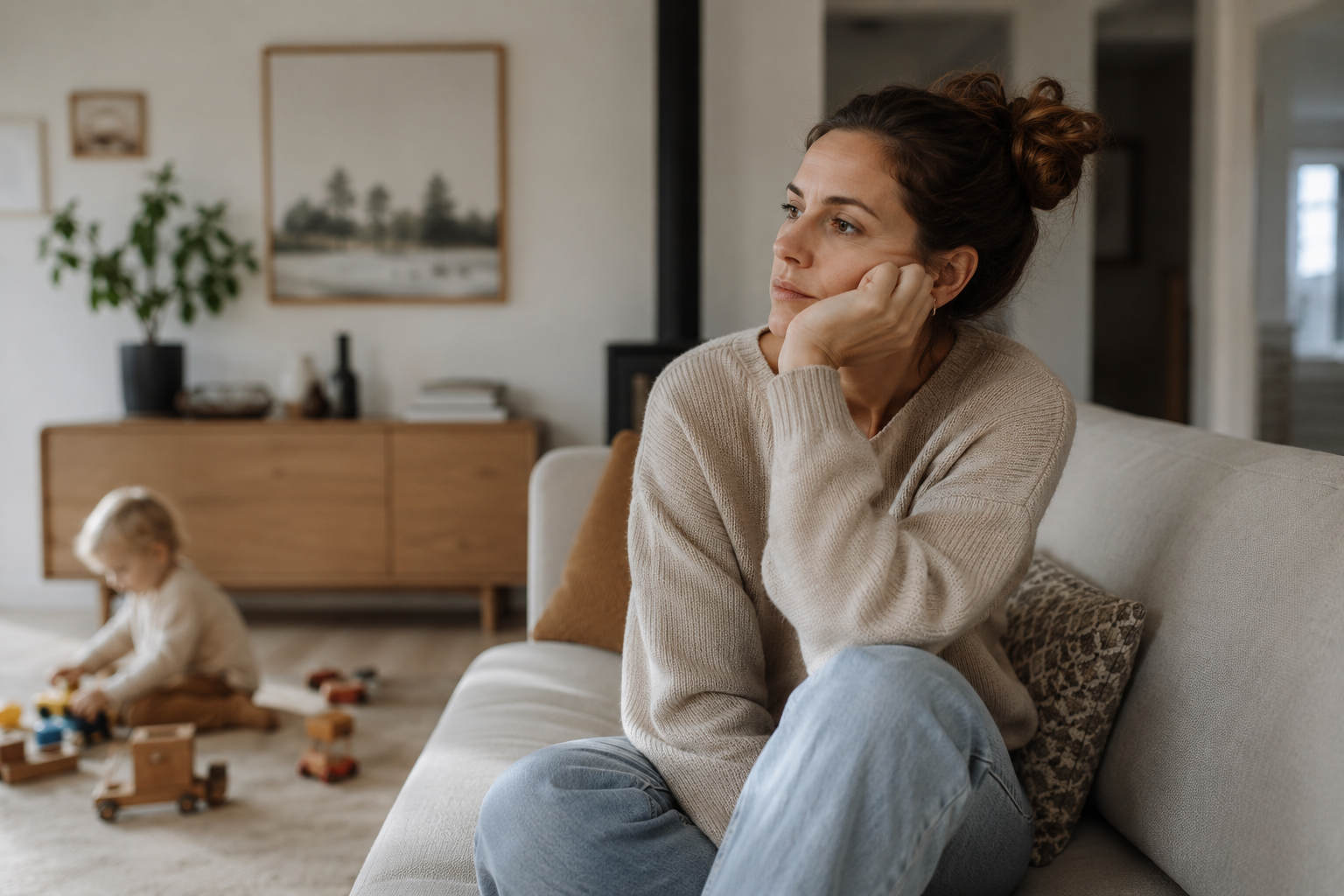
I’m writing to the woman who quietly wonders if something is wrong with her because she loves her children with every fiber of her being and yet staying home feels like she is dying inside.
Over the last twenty years, both as a therapist and as a mother, I’ve sat with countless women who made the decision to stay home because they believed it was the right thing to do. Many of them suffered from what we might call the disease of unfulfillment.
Its symptoms don’t always look the way people expect. They often show up as chronic irritability, low-level depression, persistent exhaustion, body pain, or physical symptoms that never seem to fully resolve. There is frequently a quiet boredom that no one wants to admit out loud. There is guilt because she isn’t enjoying this season the way she thought she would. There is distraction because even while she’s sitting on the floor playing with her child, she feels like she’s only going through the motions.
She isn’t absent because she doesn’t love her child. She’s absent because she’s lost touch with herself.
One of the clearest behavioral symptoms of the disease of unfulfillment is micromanaging. She doesn't micromanage because she’s controlling by nature, she micromanages because the parts of her that long to create, contribute, build, lead, and explore have nowhere healthy to go.
She has leadership with nowhere to lead. She has creativity with nowhere to create. She has energy with nowhere meaningful to express itself. When those parts of us are under-expressed, they don’t simply disappear. They often reappear as control, perfectionism, resentment, and micromanaging.
This isn’t peaceful stillness. It’s a life that no longer fits.
The truth is, I know women who stay home with their children and feel deeply alive. Their lives are beautifully aligned with who they are. I also know women with successful careers who feel deeply unfulfilled. This isn’t about staying home or going back to work. It’s about alignment. It’s about whether the life you’re living reflects the woman you are. When it doesn’t, something inside of us slowly begins to wither.
The internet doesn’t make this easier.
Good moms want to be with their children all the time.
Mothers who prioritize their own wants are selfish.
Daycare is dangerous.
Children need their mothers every minute until they’re three.
Whether those messages come from social media, parenting experts, family members, or the culture at large, they all carry the same implication: if you feel pulled toward something beyond motherhood, maybe you aren’t devoted enough.
I think that’s one of the cruelest lies we’ve told women.,Because underneath all of this is a fear that I hear over and over again.
If I feel unfulfilled staying home, maybe I don’t love my children enough.
Can we please throw that one in the garbage?
We can love our children with every cell in our bodies, be deeply devoted mothers, and still not be fulfilled staying home full-time. Those things are not mutually exclusive.
In fact, I think we’ve been asking the wrong question.
We spend so much time asking whether mothers should sacrifice for their children that we rarely stop to ask what happens to children when they watch their mother slowly sacrifice herself.
It is my bias—one that comes from nearly twenty years of being a mother myself, more than twenty years of listening to women in my therapy office, and decades of research and study—that our children do not benefit from our selflessness.
They benefit from being raised by mothers who are living full lives.
That doesn’t necessarily mean building a business or climbing a corporate ladder. It doesn’t even necessarily mean earning a paycheck. It means staying connected to the parts of ourselves that long to create, contribute, build, lead, explore, and make a difference. It means taking seriously the quiet pull toward the things that make us come alive instead of assuming motherhood requires us to silence those parts forever.
When we pursue a purpose outside of motherhood—whether that purpose is large or small—when we take our dreams seriously enough to pursue them, when we are willing to do hard things because they matter to us, when we follow the song of our heart and the flutter of our soul, and when we cherish ourselves enough to trust that we know what is best for us instead of abandoning ourselves in the process of becoming a mother, we model something extraordinary to our children.
We show them what it looks like to trust themselves. We show them what it looks like to build a life that reflects who they really are. We show them that loving your family and loving your own life are not competing goals.
Fulfillment is not the opposite of devotion. It is often what allows devotion to become joyful instead of dutiful. This is the kind of mother I want to be.
So if you find yourself suffering from the disease of unfulfillment, consider this a love letter to your heart, to your soul, and to the part of you that has been quietly whispering that there is more.
Following that whisper is not abandoning your child, and abandoning yourself isn’t the price of becoming a devoted mother.
You can take your child’s heart with you as you walk out the door toward fulfillment. You can be deeply devoted to your children while also being deeply devoted to becoming fully yourself.
I don’t believe those two things compete with one another.
I think they grow together.